
Premium Calfskin Knit The Row Shoulder Bag
The Idea Behind Why The Row Bags Have No Logo: A Design Language Without a Badge
Pick up a bag from The Row and the opening note is an omission. You will find no monogram print, no plaque bolted to the front panel and no oversized initial swinging from a handle. The label was founded in 2006 by Mary-Kate and Ashley Olsen and named after Savile Row in London, and that reference is no piece of decorative packaging; it is a construction brief. A Savile Row jacket is read through cut, cloth and hand finishing rather than any badge, and the same thinking shapes the leather goods. The decision touches everything downstream: silhouette, hardware finish, lining and the way the bags are priced on the observed 2026 market. What follows is a design-led row bags overview and not a shopping list, since it goes through the specific choices that carry identity once the logo is gone.
Absence as the Argument
Removing the logo is not a neutral act, because a logo does a good deal of unseen work for a handbag. It signals the price bracket at ten paces, flatters the owner by broadcasting the purchase, and permits a factory to hide mediocre construction behind a famous symbol. Strip it away and every one of those jobs has to be handed over to something physical. Now the shape has to read at a distance, the leather has to look expensive to the row bags classic top handle a stranger who cannot name the brand, and the seams have to hold up under close inspection. That is why the row bags are so regularly described as difficult to photograph and easy to recognise in person. The design language is a series of substitutions, and each swap costs money that a printed monogram would have spared.
What Does the Monogram’s Job
Silhouette, proportion and construction are the three things that carry identification on a row bag. Silhouette is the outline you read before any detail resolves, and it is doing the work a logo usually does. Proportion is the internal rhythm of that outline, the relationship between width, depth and handle drop that makes one crescent shape look resolved and another look generic. Construction backs up the first two once the bag is in your hands, by way of stitch density, edge finishing and the way panels meet. None of the three can be introduced late or applied as a sticker at the end. They are decided at the pattern stage, which is why the approach is expensive to copy and awkward to fake.
Silhouette Does the Work of a Name
The catalogue is ordered by shape names rather than seasonal collections, and buyers use those names exactly as they would a monogram. Margaux, Park, Half Moon and the 90’s Bag carry the line, each a separate geometric idea rather than a variation on one theme. Officially listed at 8 x 13.5 x 2.5 inches, the Half Moon is a shallow crescent, and because published dimensions differ between sources the figure is best read as an official reference point rather than a settled number. At 10 x 7 x 7.5 inches with a five-inch handle drop, the Soft Margaux 10 has a squared, upright stance that no soft hobo can approach. The Margaux Shoulder 12 runs to 14.75 x 9 x 5 inches with elongated tubular handles and narrowed gusseted side panels, making it a wholly different object despite the shared family name. Once you can read these outlines, the row bag in front of you identifies itself without a word of branding.
A few silhouette cues are worth learning first, because they repeat across the line:
- Belted gussets at the sides, protective metal feet, on the Soft Margaux family
- Elongated tubular handles with signature adjustable buckles on the Margaux Shoulder 12
- A tall, narrow upright body on the N/S Park Tote against the wider standard Park Tote
- A hinged frame closure and hidden adjustable strap on the Bourse Clutch
- The Half Moon’s crescent, shallow and cut far flatter than a conventional hobo
The Number Means Inches
The second stand-in for branding is arithmetic, and here it is strikingly literal. That number beside a model name is the bag’s width in inches; it is neither a collection code nor a marketing tier. The same is true across Margaux 10, 12, 15 and 17, India 10.00, 12.00 and 15.75, Agnes 12 and 15, Sofia 8.75 and 10, and Marlo 12 and 14, each stepping up in exact inches. The convention gives buyers a shared vocabulary that needs no images, which matters for products that photograph almost identically across sizes. It also underlines the point of the design language, since the naming describes the object instead of dressing it up. When a system tells you the dimensions instead of telling you a story, it is asking to be judged on the object itself.
Two Stamps, Kept Deliberately Small
The bags are not unmarked in the literal sense; the marking is simply calibrated to be found rather than seen. There is a small exterior stamp positioned low on the side of the bag, sized and placed so it blends into the leather instead of advertising itself. Inside, a second stamp is crisply centred and reads the logo and the words Made in Italy. That interior mark appears on the brand’s own product pages for the Half Moon, the Soft Margaux 10 and 12, the Margaux Shoulder 12, the Bourse Clutch, the Terrasse To-Go and the Large Slouchy Banana. The logic of that placement squares with the rest of the row fashion vocabulary, in that the information is there for anyone paying attention and invisible to everyone else. It is branding as a footnote rather than a headline, and it is the closest the bags come to signing their own work.
The Luxury Is Turned Inward
Hardware is where most labels make up for restraint elsewhere, typically with polished gold that catches light across a room. The Row goes the other way with palladium-plated fittings in a matte or brushed finish that deliberately refuses to shine. The result is metal that reads as weight and precision instead of jewellery, and it ages without the scratch map mirror-polished plating develops. The same rule applies to the linings, which are treated as materials in their own right instead of canvases for repeated logo jacquard. You will find nappa, lambskin, calfskin and cotton herringbone doing that job, including the cotton herringbone lining in the Soft Margaux 10 and the full lambskin lining in the Margaux Shoulder 12. Look at the label’s shoes and the same restraint appears, with a plain last and an unadorned toe carrying the identity, which is the plainest proof that the no-logo position is a house philosophy and not a bag-department decision.
The Price of the Quiet
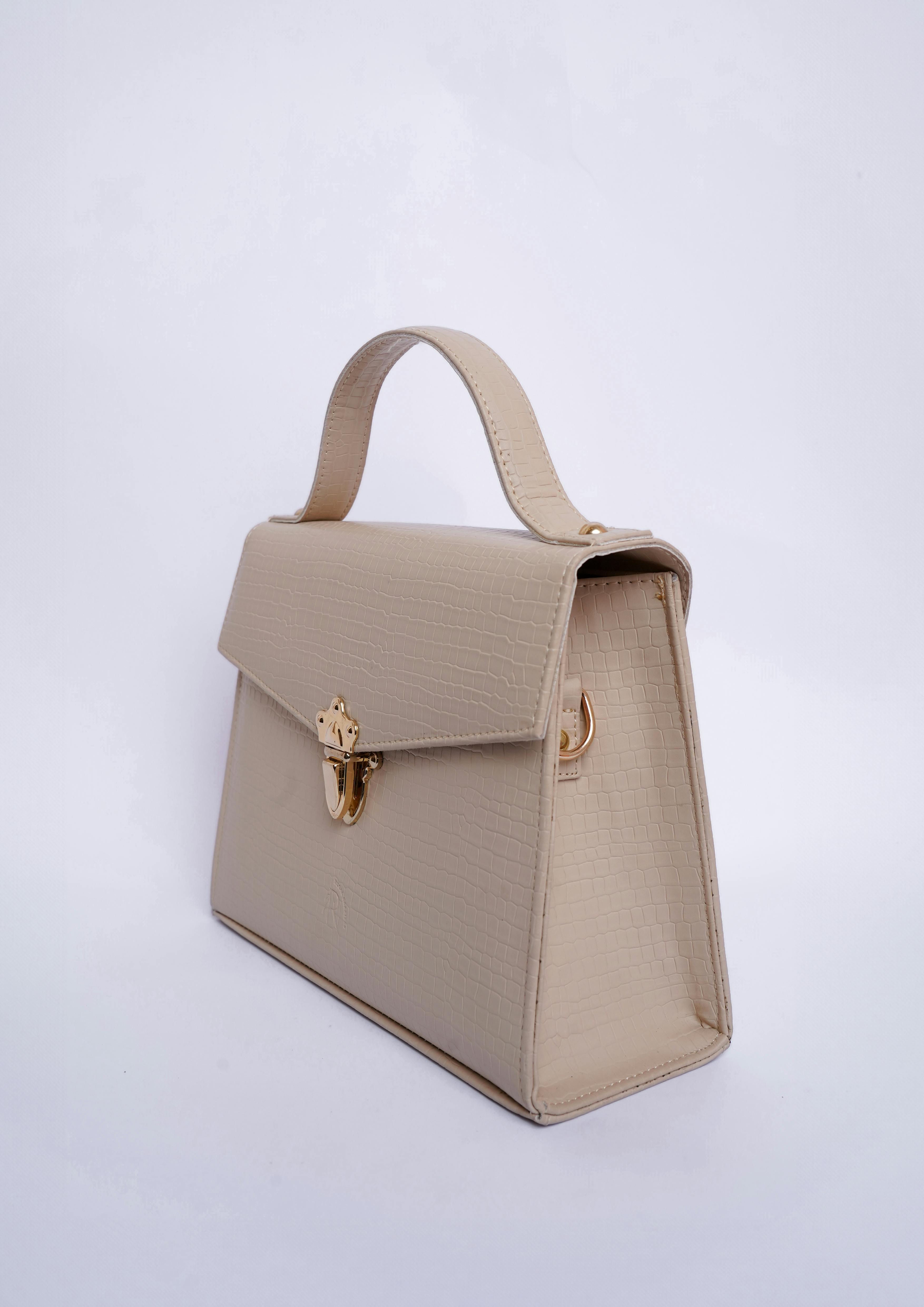
None of it comes free, and the observed 2026 market prices reveal where the money goes. A buyer is paying for pattern work, hide selection, hand-finished edges and hardware that has no decorative function, none of which produces a recognisable badge. Selling that proposition is hard, and it explains why the range runs unusually wide rather than clustering around a single hero price. The table below places anchor models against the detail that identifies them in place of a logo, using observed 2026 market prices rather than an official price list, which the brand does not publish. Take the right-hand column as the real branding, because in this system that is exactly what it is. Stock, region and retailer all move the figures, so take them as a snapshot rather than a settled tariff.
| Model | 2026 observed price | What identifies it instead of a logo |
|---|---|---|
| 90’s Bag | $1,090 | Soft, slouched shoulder body, minimal seaming |
| Half Moon | $1,390 | The shallow crescent cut, official 8 x 13.5 x 2.5 in |
| Bourse Clutch | $1,590 | A hinged frame closure, nappa lining and hidden strap |
| N/S Park Tote Small | $1,550-1,620 | A tall, narrow upright body with an unstructured stance |
| Soft Margaux 10 | $3,650 | Belted side gussets, protective metal feet, herringbone lining |
| Margaux Shoulder 12 | $4,900 | Elongated tubular handles, adjustable buckles, lambskin lining |
Putting the Design Language to Work
If you are learning row handbags at this level, the useful skill is not memorising names but learning to look in the right order. Start with the outline, then check proportion against the inch number in the model name, then move to the seams and the edges. Hardware comes next, judged on weight and finish rather than shine, and the lining last, because it confirms rather than introduces. The sequence also guards you when a row bag is offered secondhand, because counterfeits reproduce shapes far more easily than they reproduce edge finishing and matte plating. Carry the same habits into any listing of the row for sale, where photographs flatten precisely the qualities that matter most. Once you have learned the grammar, the whole catalogue reads clearly, which is precisely what a design language without a logo asks of you.
